Hardware Overview
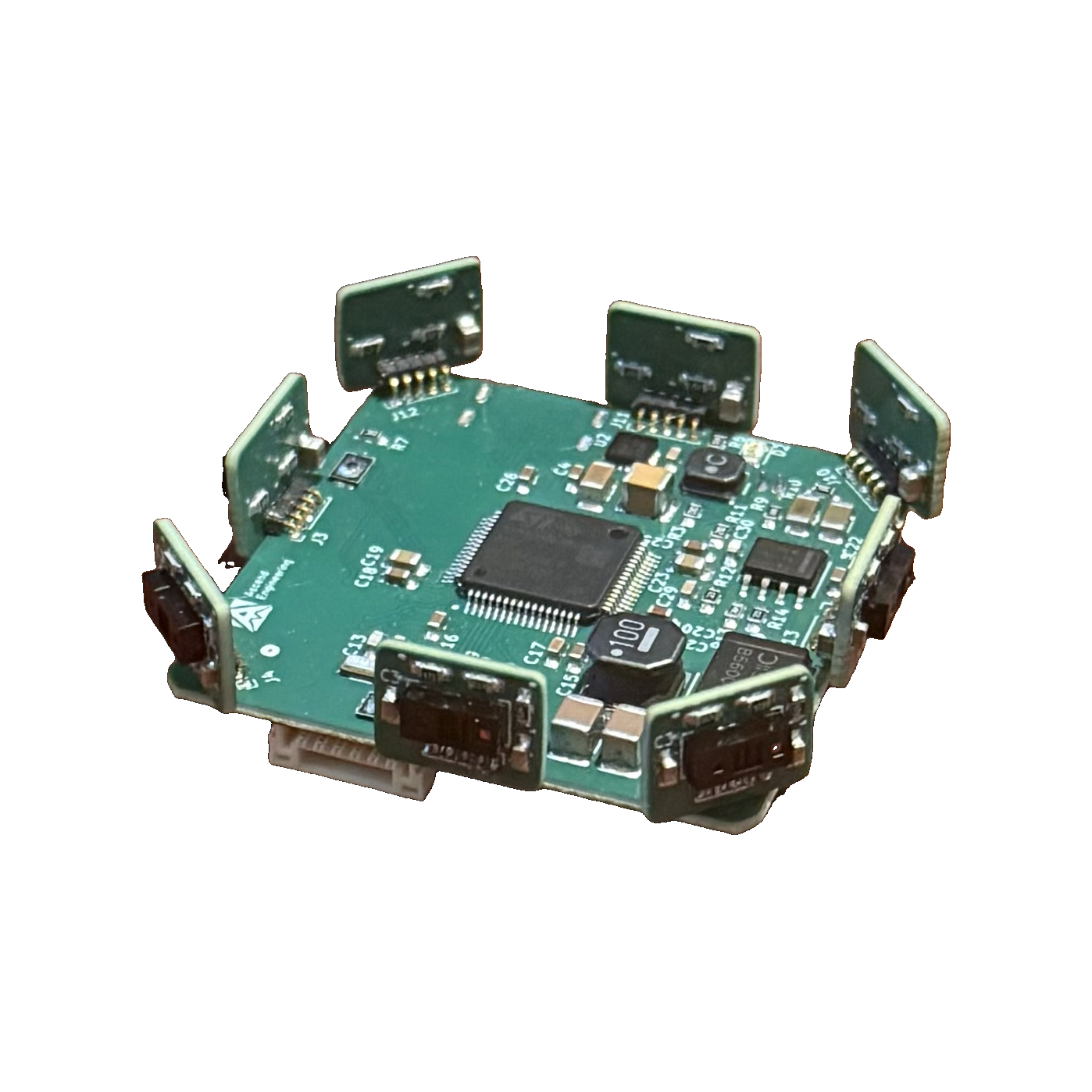
The Ascend-8tof is a 360° time-of-flight obstacle-sensing system made of two board types:
- Main / carrier board — an STM32H5-family MCU with onboard power regulation, a USB-C port, a host UART, and eight sensor connectors.
- TOF sub-board (×8) — one small board per channel carrying a single VL53L8CX 8×8 multizone time-of-flight sensor. Up to 8 plug into the main board to form the 360° ring.
See Power for supply/current limits and Communications for the UART output the board produces.
Sensor at a glance
| Property | Value |
|---|---|
| Sensor | VL53L8CX multizone ToF |
| Zones per sensor | 8 × 8 (64 zones) |
| Sensors per board | up to 8 (360° coverage) |
| Update rate | 15 Hz per sensor |
| Reliable range | ~4 m (8×8 mode) |
| Per-sensor field of view | ~45° per axis |
Connectors & pinouts
Everything an integrator needs is on three externally-relevant connectors plus the eight sensor ports.
| Connector | Purpose | Notes |
|---|---|---|
Power in (J1) |
External DC input | 2-pin; see Power for the voltage/current range |
USB-C (J2) |
Power + USB | Alternative to J1 for bench use |
Host UART (J7) |
Data/telemetry out | 4-pin — this is how you talk to the board |
Sensor ports (J3–J6, J10–J13) |
TOF sub-boards | 8× 5-pin, one per channel |
Host UART connector (J7) — 4-pin
This is the board's interface to your flight controller or onboard computer.
| Pin | Signal |
|---|---|
| 1 | +5 V (power input — you can power the board from here) |
| 2 | RX (into board) |
| 3 | TX (out of board) — connect to your host's RX |
| 4 | GND |
Wire pin 3 (board TX) → host RX and pin 4 → host GND. See Communications for the data format and Integration for host wiring.
Sensor connector (×8) — 5-pin
All eight sensor ports are identical 5-pin connectors:
| Pin | Signal |
|---|---|
| 1 | Sensor supply (high) |
| 2 | Sensor supply (low) |
| 3 | SCL |
| 4 | SDA |
| 5 | GND |
Each port maps to a fixed channel number, which in turn fixes that sensor's bearing in software:
| Connector | Channel | Connector | Channel |
|---|---|---|---|
| J6 | CH0 | J12 | CH4 |
| J5 | CH1 | J13 | CH5 |
| J4 | CH2 | J10 | CH6 |
| J3 | CH3 | J11 | CH7 |
Dimensions & weight
| Item | Size |
|---|---|
| Main / carrier board | 40 × 40 mm |
| TOF sub-board (each) | 11.4 × 8.8 mm |
| Assembled footprint | 40 × 40 mm |
| Assembled height | ~10 mm (the sub-boards stand vertically around the perimeter) |
| Weight | to be confirmed |
Mechanical / mounting
- Mount the board flat on top of the flight-control unit (FCU) with CH3 (J3) facing the vehicle nose; the eight sensors then look outward in ~45° increments to form a 360° ring.
- See the bearing table in Integration → Extrinsics for the per-channel directions.
- Sensors sit close to the FCU center, so mounting translation is negligible at meter-scale mapping (rotations are what matter).